If you open LinkedIn today, it looks like someone has tipped a cereal box of letters over digital marketing. "Forget SEO, now you need GEO", says one post. "If you are not doing LLMO, you do not exist", says another. "Have you optimised for AISO yet?"
At Marte we know that behind every new acronym there are usually two things: a real technological evolution and a lot of agencies trying to sound smarter than they are.
Today we are going to cut through that noise. We are going to explain what these terms really mean, why everyone is saying almost the same thing and, most importantly, what you need to do so your business remains the answer that users (and AIs) find.
The dictionary of the future (without the unnecessary jargon)
Although it may seem chaotic, each term tries to describe one facet of how Artificial Intelligence consumes the information on your site.
AIO (AI Optimization): This is the "umbrella" term. It refers to optimising your content not only so that Google indexes it but so that machine learning models understand it. It is basically writing so that both humans and machines can process your value without effort.
AEO (Answer Engine Optimization): This is the art of being the "single answer". You know when you ask Alexa or Siri something and you get one answer? That is AEO. It focuses on appearing in featured snippets and voice search results.
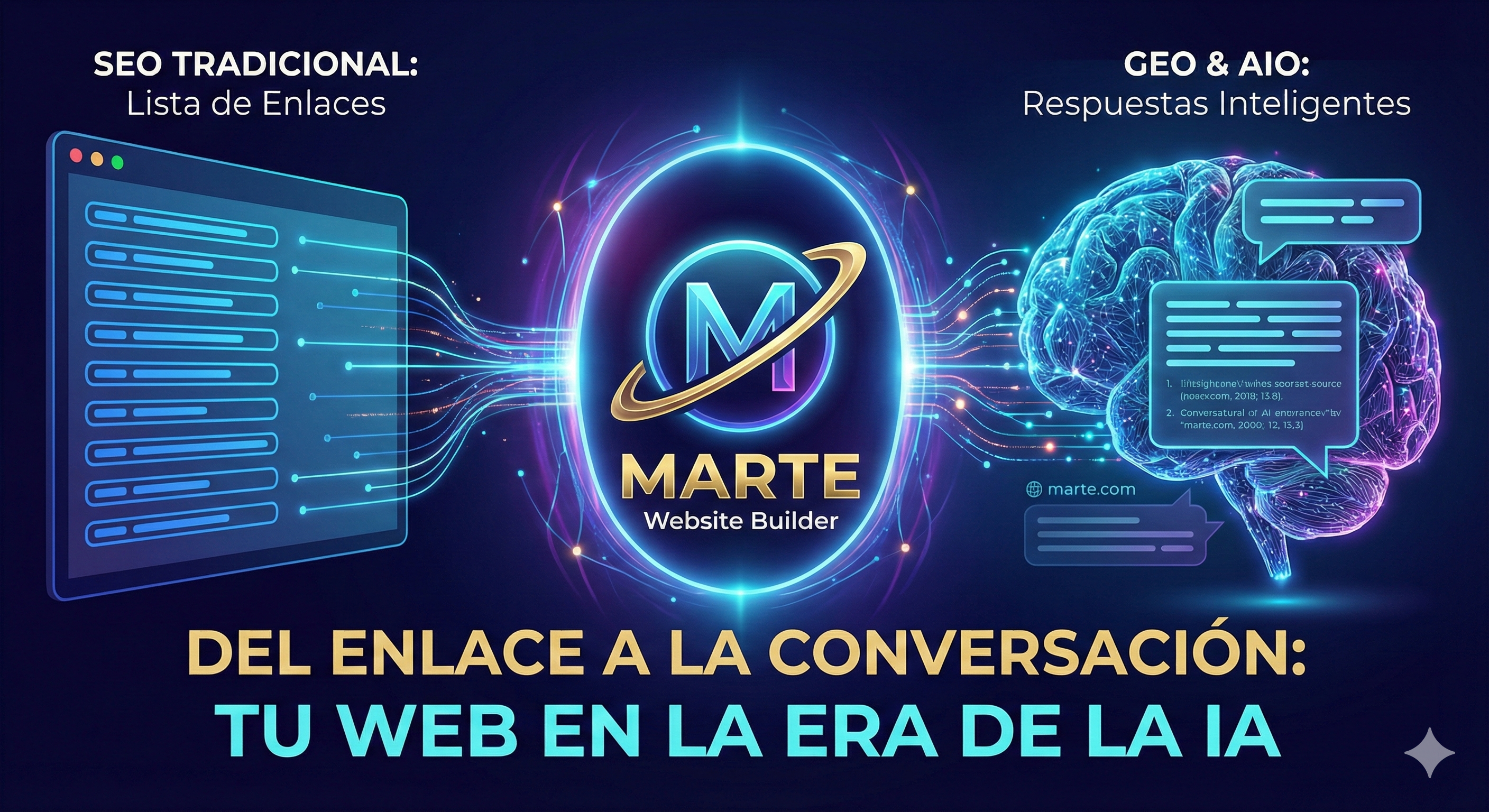
GEO (Generative Engine Optimization): This is the one we like most at Marte. GEO focuses on having generative engines like ChatGPT, Gemini or Perplexity cite your site as a source. It is not just about being on the list; it is about being the reference the AI trusts to build its answer.
AISO (AI Search Optimization): Here we move away from exact keywords to focus on semantics. AISO aims for your brand to be relevant by concept and intent. It no longer matters only that you say "red shoes"; what matters is that it is understood that you are an expert in "durable artisan footwear".
LLMO (Large Language Model Optimization): This is optimisation specifically for Large Language Models. The goal is that when a user interacts with an AI, it includes your brand naturally in the conversation because it considers you an authority on the topic.
Here is the secret: AIO, AEO, GEO, AISO and LLMO are, in essence, three names for the same idea. All these acronyms converge on one point: the evolution of SEO towards authority and structure. We no longer win by repeating a keyword ten times; we win because our site is the most reliable, fast and easy-to-read source for an intelligent system. Deep down, all these acronyms aim for your brand to be "citable".
The 4 strategies that actually move the needle (and that you can apply today)
Forget the fads and focus on these pillars that we have built into Marte's architecture:
A. Create authority-based content: AIs do not invent information (or they should not); they extract it from sources they trust. To be that source, you need: to document real experiences with metrics; to share detailed case studies (what worked and what did not); to sign your articles as an expert. The AI looks for real authors with an online presence.
B. Structure for fast extraction: If an AI lands on your site and finds messy code or endless, meaningless paragraphs, it will leave. Use headings (H2, H3) that answer direct questions. Implement structured data (Schema Markup). Include FAQ sections with concise answers.
C. Naturalness over keywords: Only 5.4% of AI answers on Google match the user's search exactly. This means the AI understands context. Stop writing for the 2010 robot and start writing to solve human problems clearly and directly.
D. Distributed authority: The AI does not only read your site. It reads Reddit, forums, press releases and social media. If you want ChatGPT to talk about you, people have to be talking about you elsewhere. Visibility today is an ecosystem, not an island.
How does Marte fit into all this?
At Marte we do not just build sites that look good; we build infrastructure ready for AI.
1. Clean, ultra-fast code: If your site takes 5 seconds to load, AI crawlers use up their resources and leave. Marte is optimised to pass all Core Web Vitals in the green, ensuring generative engines index you with priority. 2. Semantic architecture: Our templates are designed so that the information hierarchy is crystal clear. We make it easy for AIs to extract your data and cite you as a source. 3. Goodbye to technical noise: We remove heavy plugins that clutter the code. Less technical clutter means more clarity for generative search algorithms.
The future of the internet is not about chasing the latest trendy acronym. It is about trust. If your site is technically impeccable, your content is genuinely useful and your brand has authority, it will not matter what letters they invent next year: you will still be in the answer.
At Marte we take care of the complex part (technology, performance and GEO structure) so you can focus on what you do best: growing your business.
Is your current site ready for an AI to recommend it, or is it just a digital brochure from the last century?