Imagine you open the best restaurant in town. The chef is outstanding, the ingredients are unbeatable, and the decor is exquisite. But there's one small detail: the restaurant is in a third basement, has no sign on the door, and on Google Maps it shows up as "Closed commercial premises".
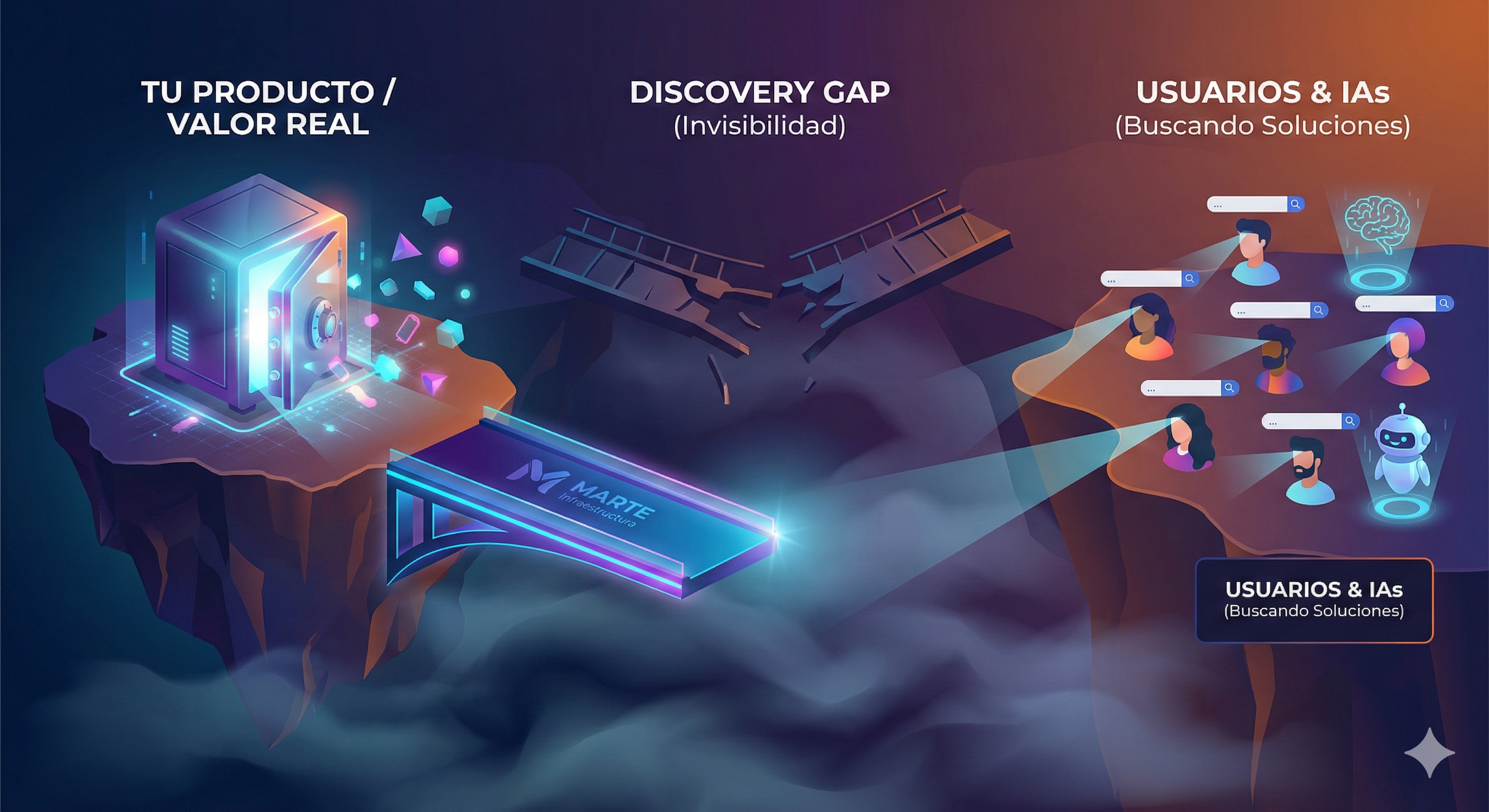
That gap between your real quality and what the world sees is the Discovery Gap.
In the digital world, this phenomenon is the silent killer of thousands of businesses. You can have revolutionary technology or impeccable service, but if your web infrastructure doesn't "connect" with how people and AIs search today, you simply don't exist.
1. What exactly is the Discovery Gap?
The Discovery Gap happens on two levels that, although they seem different, stem from the same problem: lack of structural clarity.
In Product: It's when you develop an incredible feature in your software, but your users never use it because they don't know it exists or don't understand how to get to it. In Marketing: It's when your value proposition is excellent, but search engines (and now generative AIs) fail to "read" your relevance.
At Marte, we're obsessed with closing this gap. There's no point having a "pretty" website if it's a technical maze for Google or a black box for ChatGPT.
2. The three horsemen of the "Gap": Why is your brand invisible?
After analysing hundreds of projects, we've identified three main reasons why this gap widens:
A. Technical bloat
If your site takes 4 seconds to load because it's full of unnecessary scripts and heavy plugins, the "discovery window" closes before it opens. Users bounce and algorithms penalise you. A slow site is, by definition, a site with a huge Discovery Gap.
B. The divorce between intent and content
Many businesses write for themselves, not for their customers. They use empty corporate jargon while the user is looking for solutions to concrete problems. If your customer asks "How do I digitise my SME for free?" and your site says "We are leaders in 360 disruptive transformation", the AI won't recommend you. There's no intent match.
C. Lack of "Citability"
In the age of GEO (Generative Engine Optimization), discovery is no longer just about appearing in a list of links. It's about being citable. If your information isn't structured so that an AI can extract a fact and say "According to [Your Brand], the key factor is X", you're out of the conversation.
3. How to close the gap: From invisibility to relevance
Closing the Discovery Gap doesn't require more ad budget, but more intelligence in your infrastructure. Here's the roadmap we apply at Marte:
Step 1: Optimising the "Contact Surface"
Your site must be lean. At Marte, we remove all the noise so that content is the first thing crawlers find. Less code, more speed. If Google's or OpenAI's bot can process your site in milliseconds, your discovery gap starts to shrink.
Step 2: Semantic Information Architecture
Don't hide your "gems". Your site's structure (your H1s, H2s, structured data and FAQs) must be a perfect map of what you offer. If you sell "legal consultancy for startups", that phrase should be the beacon, not a footnote on page 4.
Step 3: Building Real Authority
Modern discovery is based on trust. AIs recommend sources that look expert. This is achieved by publishing your own data, real case studies and well-founded opinions. Stop being an echo and start being a source.
4. The role of Artificial Intelligence in closing the Gap
AI is both the biggest risk and the biggest opportunity for the Discovery Gap. On the one hand, it makes it harder to be discovered in the traditional way (people no longer do infinite scroll on Google). But on the other hand, if you get the AI to understand you, you go from being "one option among ten" to being "the suggested recommendation".
At Marte, we've designed our technology with this new paradigm in mind. We don't build sites for the 2015 internet; we build them for the conversational internet.
Conclusion: Don't let silence kill your business
The Discovery Gap is the difference between what you are and what the world allows you to be. In a saturated market, visibility is a privilege earned through performance, clarity and structure.
Having a site on Marte is like putting a stadium spotlight on that basement restaurant and building an escalator straight from the main street. It's about stopping being a secret and becoming an answer.
How wide is the gap between your product and your potential customers right now?