
A change has just happened in one of the world's largest digital ecosystems and most business owners are ignoring it because they think it doesn't affect them.
Amazon has changed how buyers discover products. It has moved from a keyword-based model to a model driven by contextual relevance powered by artificial intelligence. Its tool, formerly called Rufus and now rebranded as Alexa for Shopping, doesn't search the catalogue by exact terms. It evaluates which page best answers the specific question the buyer is asking and recommends accordingly.
The direct consequence: brands whose pages are structured so AI can read and understand them get recommended. Those that aren't simply stop existing in that conversation, even if they've been in the market for years.
So here's the question you should be asking: why do you think what's happening to Amazon isn't happening to you?
The same shift. Outside Amazon too.
What Amazon is doing with Alexa for Shopping isn't an exception. It's the direction the entire digital ecosystem is heading.
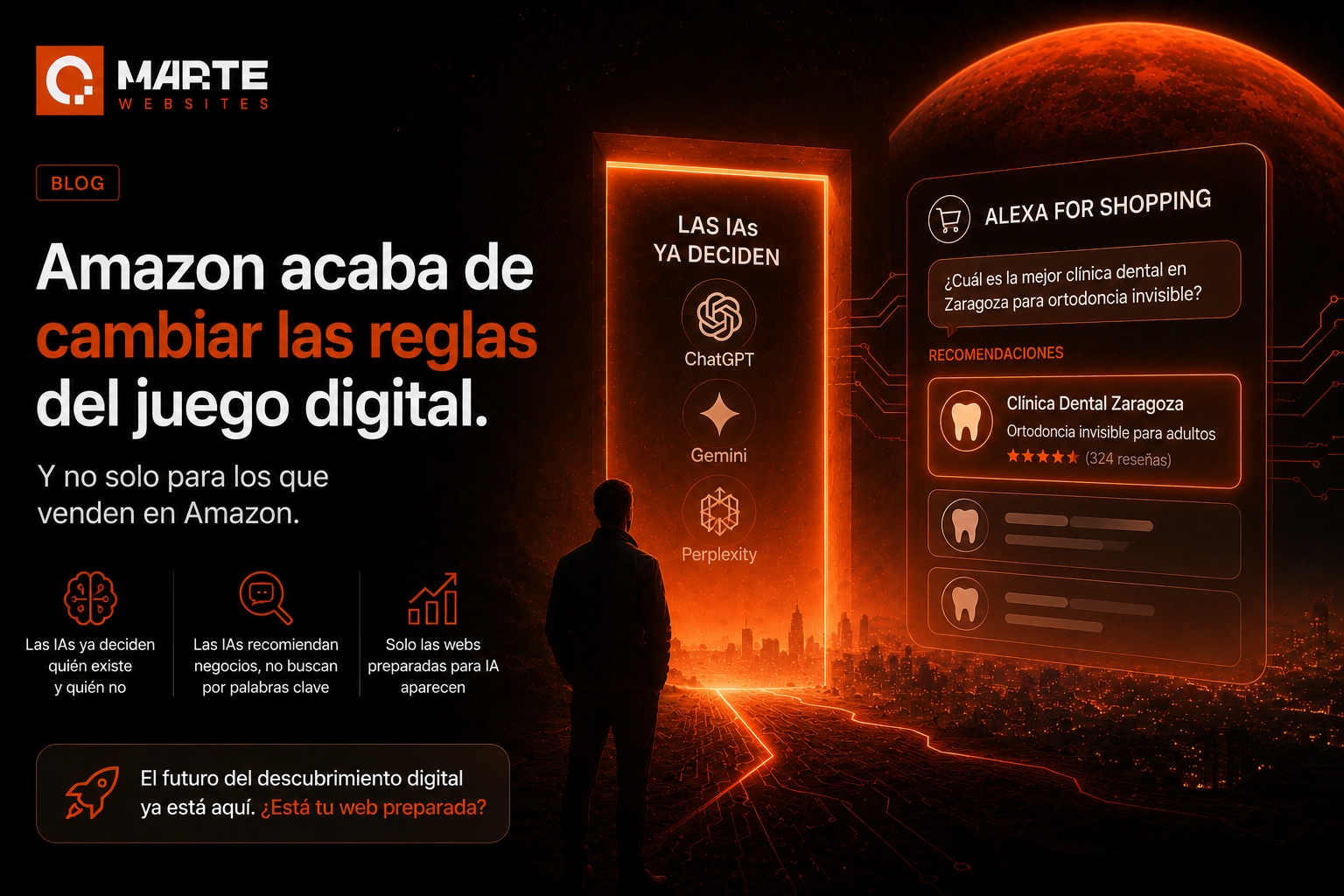
ChatGPT, Gemini and Perplexity already answer user questions with local business recommendations. They decide which dental clinic appears when someone asks for the best in their city. Which accountant to recommend when someone is looking for tax help. Which language school to suggest when someone wants classes for their kids.
And they do it with exactly the same logic as Alexa for Shopping: they don't search by keywords. They evaluate whether your website can answer the user's question better than the available alternatives.
If your website is built so AI can read, process and understand it, you appear. If it isn't, you don't exist in that conversation.
Amazon's change isn't an ecommerce story. It's the clearest and most verifiable signal that we're at an inflection point: AI already decides who exists digitally and who doesn't.
Why most websites are invisible to AI
There's a direct lesson in what Amazon is seeing with its sellers that applies to any business with a website.
Product pages designed for keyword algorithms may rank in traditional search, but AI ignores them because they can't answer the specific questions buyers ask. Not because the product is bad. Because the page structure doesn't generate the signals AI needs to process it.
The same is true for your website. A site built for Google's algorithm from five years ago may still rank in some searches. But if ChatGPT can't read it clearly, if the technical structure doesn't generate the semantic signals AI needs, you won't appear when someone asks an AI about your type of business in your city.
Here's the specific problem: most websites built on WordPress, the world's most widely used platform, aren't structured for AI. Not because WordPress is bad. But because it was designed in an era when AI didn't exist as a discovery channel, and adapting it requires a level of technical configuration most business owners don't have the time or knowledge to manage.
The three questions every website should be able to answer today
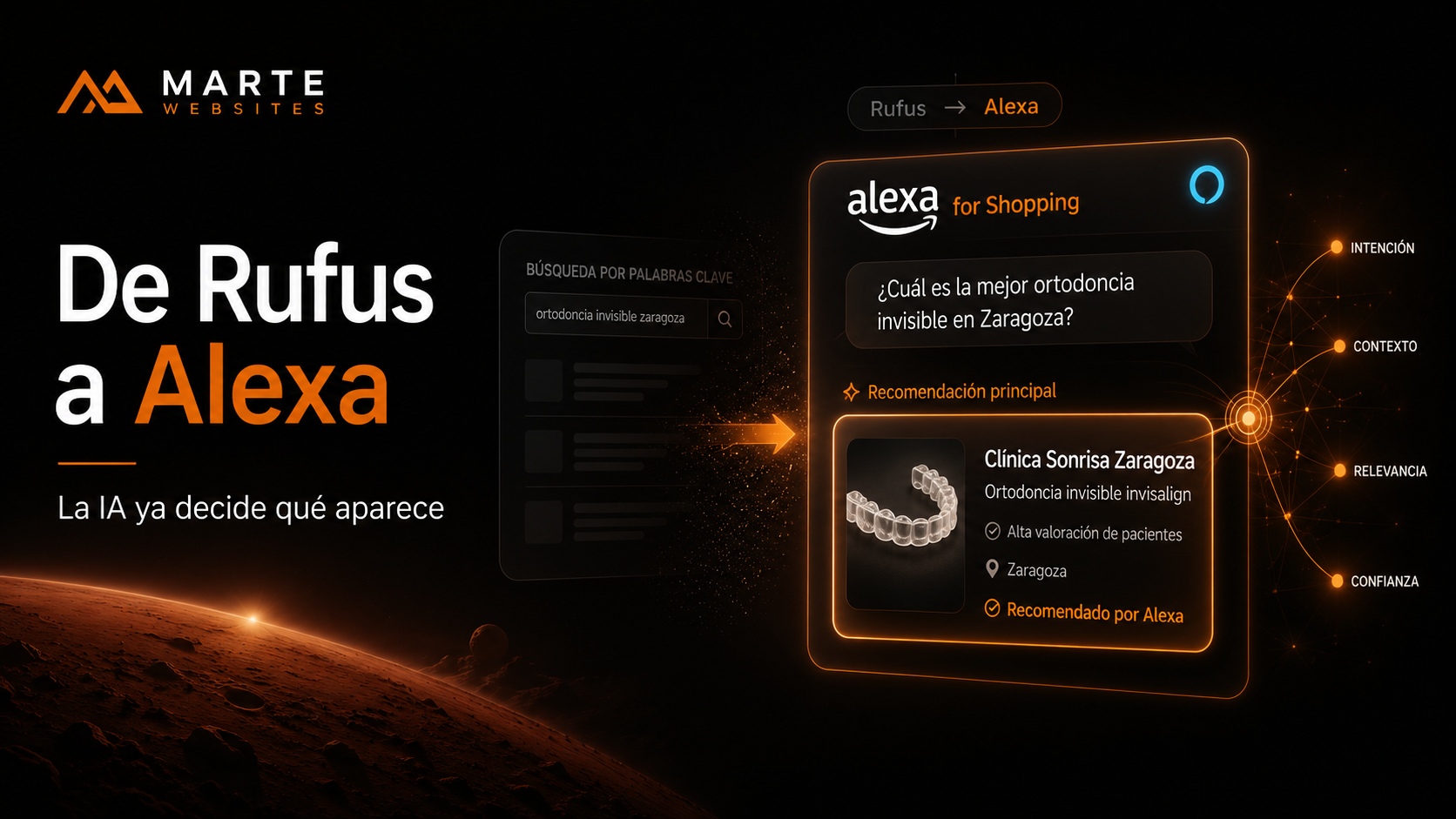
Amazon has identified precisely what makes a page get recommended by AI versus ignored. And the three questions it raises are exactly the ones you should ask about your website.
Does my website clearly explain what my business is?
AI needs to understand precisely what your business is about, what services you offer and who you serve. If your website has generic copy, unclear structure or content that doesn't directly answer the questions your potential customers ask and AI can't categorise you correctly.
A website that starts by explaining "we're a dental clinic specialising in invisible orthodontics for adults in the Salamanca district" gives AI actionable information. A website that starts with "welcome to our clinic, where oral health comes first" tells no AI anything useful.
Is my website the right result for the question my customer is asking?
AI doesn't just understand your website's content. It evaluates whether that content answers the user's specific question better than the available alternatives. That means specificity matters more than content density. A website that precisely answers specific questions is more likely to be recommended than one with lots of generic content.
Does my website's technical experience generate trust in AI?
Alexa for Shopping takes into account load speed, semantic structure and user experience quality when deciding what to recommend. So do ChatGPT and Gemini. A slow website with poor technical structure or loading errors sends negative signals that reduce the likelihood of being recommended regardless of content quality.
The advantage of moving first
Amazon documents it clearly in its analysis: brands that optimise their pages for both environments, traditional search and AI-driven discovery, get exponential benefits from both. They aren't mutually exclusive strategies. They reinforce each other.
And there's something more important: AI works through accumulated authority. The longer a business has been indexable and recommended by AI, the more references it builds, the more mentions it accumulates, the more consolidated its position becomes.
That means there's an open window right now. In most sectors and cities in Spain, no business yet dominates ChatGPT or Gemini recommendations. The position of "first recommended when someone searches for your type of business in your city" is available. But it won't be forever.
The one who acts first builds an advantage that time consolidates, exactly as happened with Google SEO fifteen years ago.
What this means for your website in 2026
Amazon's message is unambiguous: pages designed solely for keyword algorithms are already falling behind. AI-driven discovery isn't the future: it's the present, and it's growing every month.
For any business with a website in 2026, this translates to one concrete question: is your website built to be read, understood and recommended by artificial intelligence?
If the answer is no, or if you don't know the answer, it's time to change that. Not as an additional strategy. As the foundation everything else runs on.
Why Amarte exists for exactly this moment
Amarte is the website platform designed to make your business visible exactly where your customers are looking today: on Google and in artificial intelligence.
Every website built on Amarte has by default the technical and semantic structure that ChatGPT, Gemini, Perplexity and Alexa for Shopping need to read your business, understand it and recommend it. It's not an additional configuration. It's not a plugin to install. It's the architecture of the platform.
The result is a website that loads in under a second, has a 100-point technical SEO score and appears in AI responses when someone searches for what you offer, all included in a €20/month subscription, with migration managed by our team.
What Amazon is documenting in its most advanced sellers, Amarte builds into every website it creates.
The change has already happened. The question is when you decide your website becomes part of it.
The first step requires no commitment. Amarte's free analysis evaluates in 2 minutes how AI sees your current website and what's failing technically to improve that visibility.
👉 Analyse your website free at amartewebsites.com Diagnosis in 2 minutes. No calls. No commitments.