
For decades we have designed the internet around one golden rule: the end user is a person. We write so that biological eyes read, understand and click.
But at Marte we know the wind is changing. We are crossing a threshold where most of the attention your site gets will come not from humans but from Language Models (LLMs). As Andrej Karpathy puts it, we keep writing for people while ignoring that "AI attention" is about to dominate the digital ecosystem.
If your site cannot speak to them, it effectively does not exist.
1. The problem: Why does the AI "hallucinate" when it reads your site?
Sometimes we blame the AI for making things up (the famous hallucinations), but the reality is simpler: your site is noisy. Traditional documentation (heavy PDFs, endless JavaScript menus or messy HTML) is a maze for an AI agent for several reasons:
Saturation of "digital noise": Unnecessary code and complex navigation consume the AI's "tokens" (its working memory). It is like trying to read a book while someone shouts in your ear. Invisible content: AIs cannot "guess" dropdown menus or dynamic elements that only appear after a human click. Lack of a clear map: Without a structure designed for machines, AI agents have to resort to trial and error to understand what you do and how to help you.
2. The structural solution: /llms.txt
Remember the robots.txt file that told Google what to index? Well, welcome to its evolution: llms.txt.
It is a file we place at the root of your site to guide AI agents. It is not for humans; it is a "quick instruction manual" so that ChatGPT, Claude or Gemini can understand your site in milliseconds.
File llms.txt: Function High-speed index. What it contains: An executive summary, usage guide and clean links. File llms-full.txt: Function Massive context. What it contains: All your documentation in a single Markdown file, ready to be consumed in one go by the AI.
At Marte we bet on this approach because it removes visual and technical noise, allowing AI tools to extract the essence of your business with surgical precision.
3. ReadMe.LLM: How to write so they understand you
For an AI not only to read your content but to execute or recommend it correctly, we follow the ReadMe.LLM framework. It rests on three pillars:
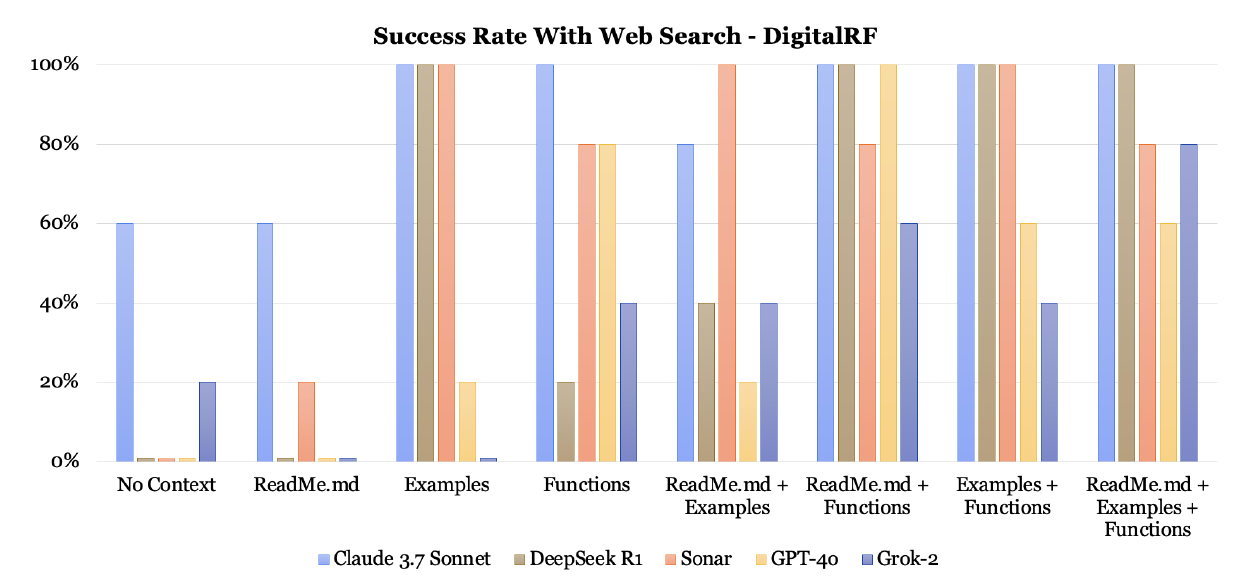
1. Behaviour rules (rules): We tell the AI how to act. "If the user asks about pricing, always prioritise the current rate over past offers". 2. Domain description (library_description): A summary that situates the AI. Do not leave it guessing; tell it who you are and what you solve. 3. Context with examples (context): Saying what you do is not enough; you must show how it is used. Mixing function signatures with real examples reduces hallucinations to almost zero.
4. The figures do not lie: From 30% to 100% success
Implementing AI-oriented documentation is not a "geek" whim; it is a business need. Recent studies are clear:
Without specific context: AI models often fail 70% of the time when trying to perform complex tasks on a site. With ReadMe.LLM: Success rates rise to 100% on models such as GPT-4o or Claude 3.7.
When you optimise for machines, you are not just being modern; you are ensuring that when a customer asks their personal assistant about a service like yours, the answer is your brand.
5. The future: Agents that act for you
The web is no longer just for "reading"; it is for acting. With protocols like MCP (Model Context Protocol), autonomous agents will soon be able to book appointments, compare insurance or manage calendars by browsing the web for us.
But for that to happen, your site must stop being a black box. The llms.txt file is the first step towards an intelligent digital presence, where machines can understand each other to save people time.
At Marte we are already building that bridge. Because the future of the internet will be generative, and we want your business to be the first to cross it.
Bibliography:
Wijaya, S., Bolano, J., Soteres, A. G., Kode, S., Huang, Y., & Sahai, A. (2025). Readme. llm: A framework to help llms understand your library. arXiv preprint arXiv:2504.09798.
Cranefield, S. (2025, October). Are LLMs and the Model Context Protocol Sufficient for Automating Web-Based Information Processing?. In Proceedings of the Second International Workshop on Hypermedia Multi-Agent Systems (HyperAgents 2025) co-located with 28th European Conference on Artificial Intelligence (ECAI 2025) (Vol. 4084, pp. 66-72). CEUR-WS.