
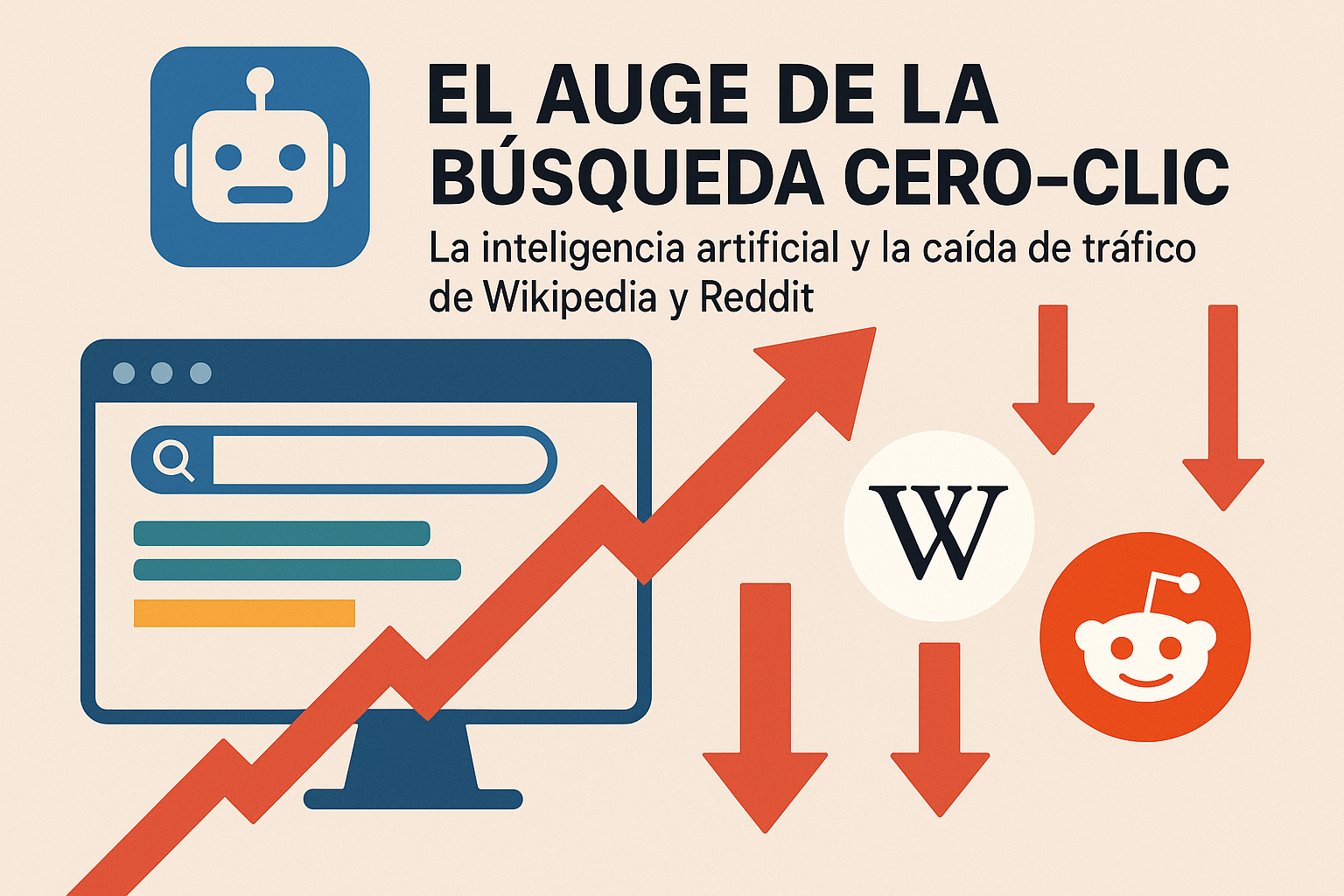
We are seeing a radical shift in global web traffic. The rapid rise of artificial intelligence is not a future trend; it is a present-day phenomenon that is displacing classic search engines and seriously affecting long-standing pillars of the internet.
If your digital strategy is still focused only on how Google "sees" you, you may be preparing for yesterday's game. Today's data paints a very different picture.
The Evidence: Wikipedia and Reddit as Barometers
The cases of Wikipedia and Reddit are symptomatic of this seismic change.
Wikipedia, the open encyclopedia that served as training data for many of these AI models, has seen a drop of around 8% in human traffic year on year. But the long-term view is more alarming: if we compare data from 2022 to 2025, the fall in monthly visits is between 23% and 26%.
That is equivalent to more than a billion monthly visits that no longer reach its pages.
Reddit is no different. The community has seen notable falls in organic visibility, with an estimated 4.5% traffic loss after Google updates that prioritise "AI Overviews" (AI-generated answers).
The cause? Direct answers and generative summaries on platforms like ChatGPT, Google Gemini and Perplexity. Users get their answer without needing to click through to the original source.
The Rise of "Zero-Click Search"
The trend is clear: generative AI is overtaking classic search in speed and user experience.
The concept of "zero-click searches" has become the new norm. More and more users get what they need directly on the results page, without visiting the original sites. On mobile, this share already exceeds 50%.
Industry estimates, such as Gartner's, suggest that by 2028 AI search will exceed traffic from traditional search engines.
This is not just a traffic drop; it is a fundamental reconfiguration of how information is discovered.
From Human-First to AI-First: The Dual Technical Challenge
For SEO professionals and small businesses, the impact is direct. Web traffic decline already ranges from 15% to 34% depending on sector.
The challenge is twofold. We no longer only compete for human attention; we compete to be the source "cited" by AI and to be "compatible" with the new AI agents.
1. SEO for LLMs (GEO)
Control over how our content is presented has moved to AI systems. So web pages must be optimised not only for traditional indexing but to be understood, interpreted and used by LLMs.
This requires a clear technical approach:
Clear structuring of information. Advanced semantic markup (Schema) that "explains" to the AI what each element is about. Clear, factual content that can be extracted and quoted verbatim.
2. "Synthetic User Experience" (SX)
The second challenge may be deeper. With the arrival of "AI Agents" (such as OpenAI's Atlas project), they no longer just "read" us; they interact with our site to complete tasks (compare, buy, book).
And these agents have as little patience as a human.
If a site is slow, or depends on heavy scripts or animations that block content loading, the AI agent will not wait. It will fail in its task and move on to the next option. A light, fast web architecture with instant response times (TTFB) is no longer an SEO advantage but a survival requirement in the age of agents.
Conclusion: The Future Is Efficient
The alarm over Wikipedia and Reddit's traffic drop is only the first symptom. The web is shifting from a network of "pages" to a network of "data" consumed by AIs.
Your site can no longer be just a pretty front. It must be a visibility, performance and conversion machine for both humans and artificial intelligences.
Marte's core message is more relevant than ever: "Your site must not only rank on Google. It must be visible to the new generation of AIs." The future belongs not to those with the most plugins, but to those with the most efficient site.