
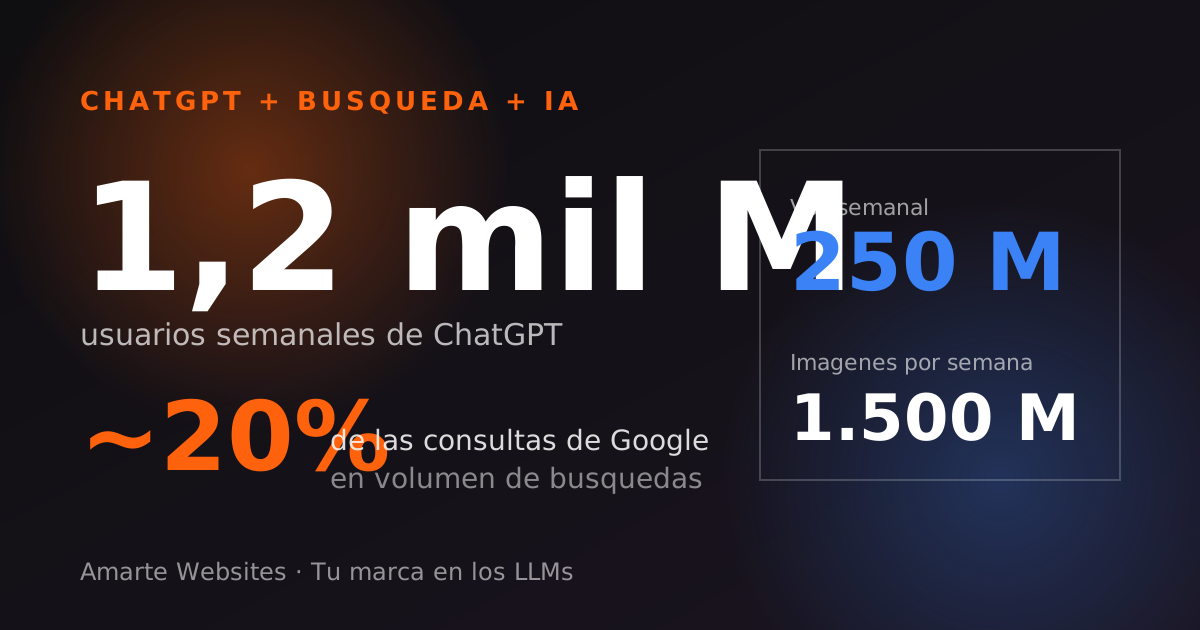
OpenAI has just shared a number that should make every business owner look up from their website: ChatGPT went from 1 billion to 1.2 billion weekly active users in about 60 days. That is 200 million new people in two months.
It was shared by Adam Fry, OpenAI's consumer product lead for ChatGPT, during a fireside chat at an OpenAI event in New York with journalist Alex Kantrowitz. These are figures from the company itself, not an independent audit, but the order of magnitude matters. Fry put it simply: "The growth is just going big."
The number we care about most: search
According to OpenAI, the volume of search-like queries on ChatGPT is now roughly one fifth of Google's. And that is with a product that, as Fry himself recalled, had no up-to-date information a year and a half ago and used to answer with "that's past my training date."
What matters is what people look for there. ChatGPT started as a tool for writing and coding. Today people use it to look up people, places and businesses, and for finance or health questions where they need current, factual information. In other words, everything you used to open a traditional search engine for.
If one in five "Google-style" searches already happens inside a chat, the question for your business is no longer whether appearing in AI matters. It is how long you can afford not to be there.
Voice, images and an ever more everyday ChatGPT
Other figures OpenAI shared point to the same pattern of mass usage:
250 million weekly active voice users, combining dictation and spoken conversations with ChatGPT.
1.5 billion images created per week with the tool.
People no longer just type a query. They talk to the AI while driving, dictate what they need and ask for recommendations without looking at a screen. In a spoken conversation there is no results page with ten blue links. There is one answer, usually with one or two recommendations. You are either in them or you do not exist in that conversation.
Chat and Work are merging: AI moves from answering to doing
Fry also revealed that OpenAI plans to merge ChatGPT's Chat and Work modes, so the toggle that confuses so many people today will go away. The direction is clear: a single assistant that converses, researches and carries out tasks.
For a business this has a practical consequence. When the AI does not just recommend but compares suppliers, books, requests quotes or prepares a purchase decision, it needs structured, clear and reliable data about your company. Websites that machines cannot read drop out of the process before the human customer ever sees them.
What this means for your website
In three ideas:
Your customers already ask an AI before they search for you on Google. And there are more of them every month.
AI recommends by relevance and clarity, not by keywords. It evaluates whether your website answers the user's specific question better than the alternatives.
The advantage belongs to whoever moves first. In most sectors and cities, no business dominates ChatGPT's recommendations yet. That position is open today, and AI systems build authority over time.
Is your website ready for a world where AI runs search?
At Amarte Websites we build every site with exactly this scenario in mind. The technical and semantic structure that ChatGPT, Gemini and Perplexity need to read your business, understand it and recommend it comes built into the platform: it is not a plugin or an add-on. It loads in under a second, has a perfect 100 technical SEO score and is designed to be cited, not just indexed.
But before changing anything, it helps to know where you stand.
Want to see your brand's presence in LLMs? Our free analysis checks in 2 minutes how AI sees your current website, whether it mentions you or not, and what is technically holding you back.
👉 Analyse your website for free at amartewebsites.com Diagnosis in 2 minutes. No calls. No commitments.
Source of the figures: Alex Kantrowitz's conversation with Adam Fry (OpenAI), published in Big Technology.